
TL;DR
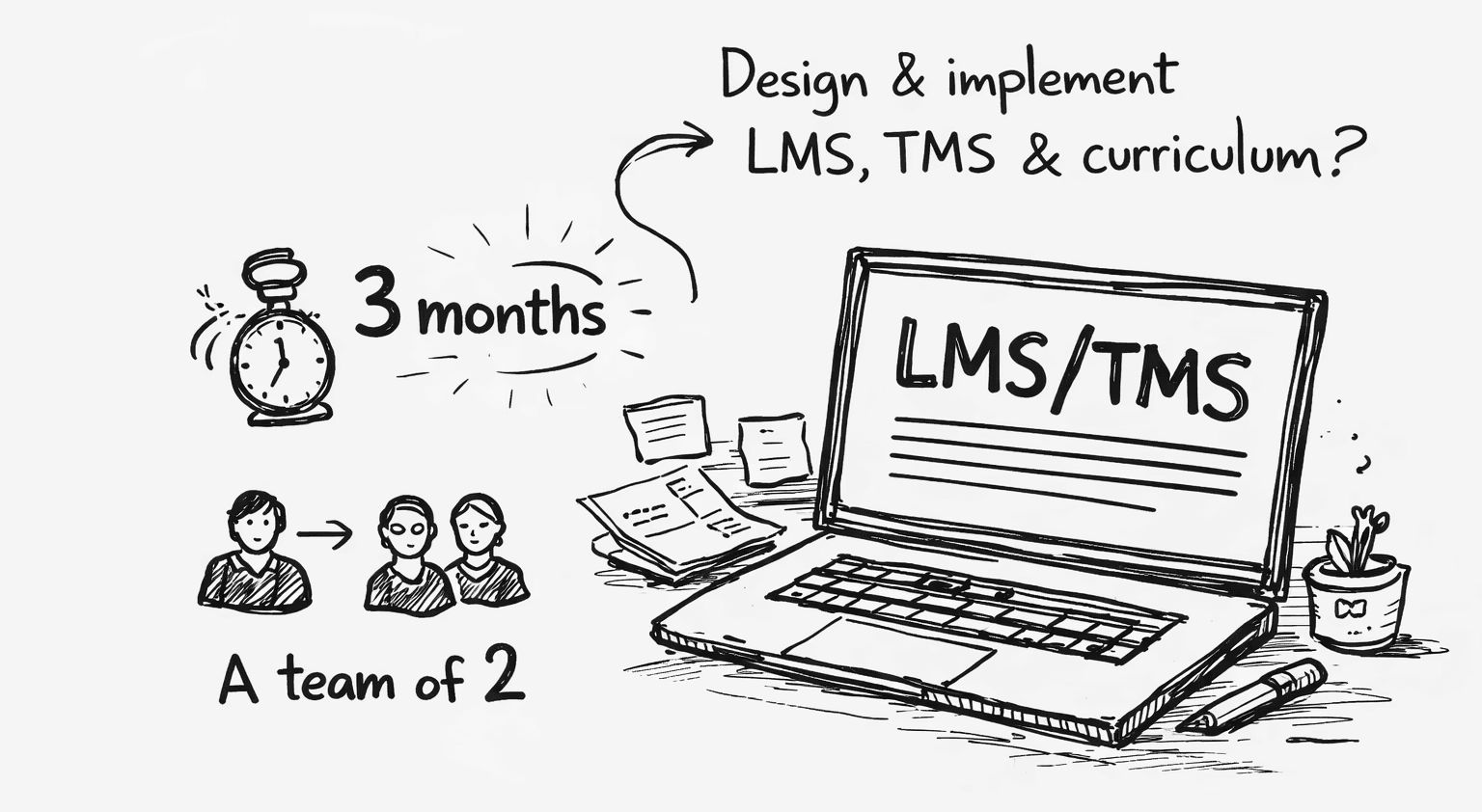
I architected and launched SPICED’s first Learning Management System (LMS) in three months, designing and evolving a relational system that coordinated learning content, cohort operations, instructor workflows, and evaluation pipelines.
Implemented in Notion and driven by system logic and workflow orchestration, the platform evolved into a stable multi-cohort learning infrastructure supporting ~750 learners and ~20 instructors, enabling the organization to scale from 2 to 12 team members and run up to 6 concurrent program streams.
Curious? Scroll down for the details…

context
the launch
When SPICED launched its UX/UI bootcamp, the company had no learning management or trainee management infrastructure in place. Each department relied on fragmented tool stacks and ad-hoc processes.
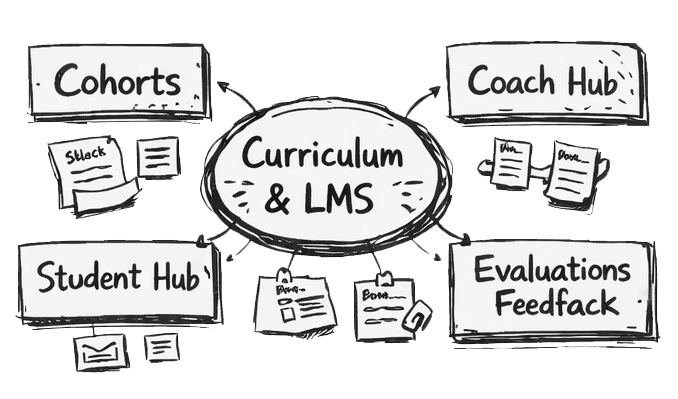
I designed and implemented the first version of this system using Notion, building a relational platform that coordinated students, instructors, learning materials, and cohort operations.
Over the next 2.5 years, the system evolved into a stable learning infrastructure supporting:
500–750 learners
~20 instructional staff
multiple parallel cohorts
CHALLENGE
LAUNCHING A PROGRAM WITHOUT INFRASTRUCTURE
Bootcamp-style education programs operate more like operational systems than traditional learning platforms.
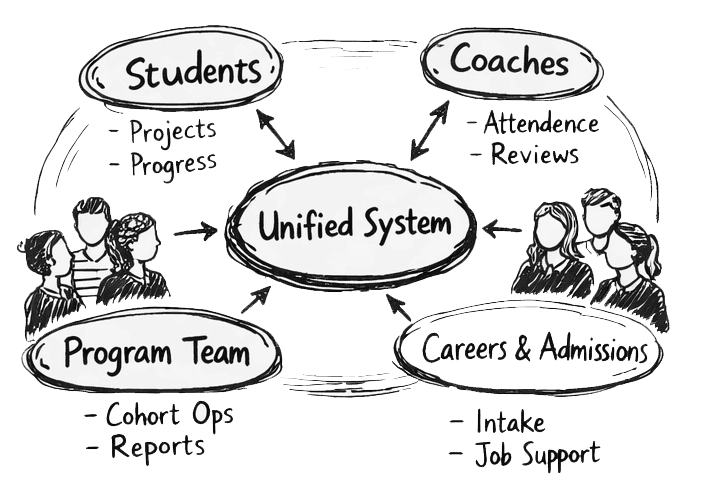
Each cohort requires coordinated workflows across multiple stakeholders: students - instructors - mentors - program managers - career teams
These workflows include: lesson delivery - mentoring sessions - assignment evaluations - attendance tracking - curriculum updates - student feedback loops.
The organization needed a system capable of supporting cohort-based learning operations at scale — and it needed to be ready in three months.
ROLES
the many hats
i got to wear
This work required autonomous decision-making under tight deadlines & resources.
I owned much of the design and setup of the LMS/TMS platform & the operational system
around it.

Platform & system design
architected the LMS/TMS structure
designed role-based environments for students and instructors
structured relational databases to support program operations

Operational design
defined instructor workflows
created onboarding protocols
developed evaluation documentation systems

Curriculum development
created student learning materials
developed instructor guides
designed exercises and projects
built presentation frameworks

Team growth
recruited and onboarded juniors
mentored junior designers
System Design
From Content Platform to Learning Operations System
Why Notion
Choosing the platform required balancing speed, flexibility, and cost.
Notion was selected because it allowed us to:
build relational databases quickly
iterate rapidly without engineering resources
keep the platform cost-free for students
immerse students in a tool relevant to their future workflows
Designing within Notion required maximizing system logic within platform constraints.
cohort abstraction
Bootcamp programs repeat the same curriculum across multiple cohorts.
Instead of duplicating content for each cohort, I designed a cohort abstraction model:
curriculum content existed independently
cohorts referenced the same content structure
instructors accessed cohort-specific operational views
This allowed the system to scale without duplicating content or introducing maintenance overhead.
Role-based environments
The platform supported multiple user groups:
students
instructors
mentors
program managers
Each group required different information and workflows. I designed role-based environments that exposed only relevant system components for each role, reducing cognitive load while preserving flexibility.
Feedback-iteration pipeline
Instructor feedback was critical for improving the curriculum. To support continuous iteration, I created a governance model where:
Instructors documented feedback on lessons
Feedback was centralized in a database
Issues were triaged into actionable tasks
Updates were integrated into curriculum revisions
This established a sustainable feedback-to-improvement pipeline.
outcomes
scaling the system
The LMS/TMS was built to support 2× business growth. The program was rapidly becoming the top revenue stream in the bootcamp portfolio.
To scale, we needed to increase:
Cohort volume (eventually 3×)
Student throughput (parallel on-site and remote delivery)
Operational capacity — without growing the team proportionally
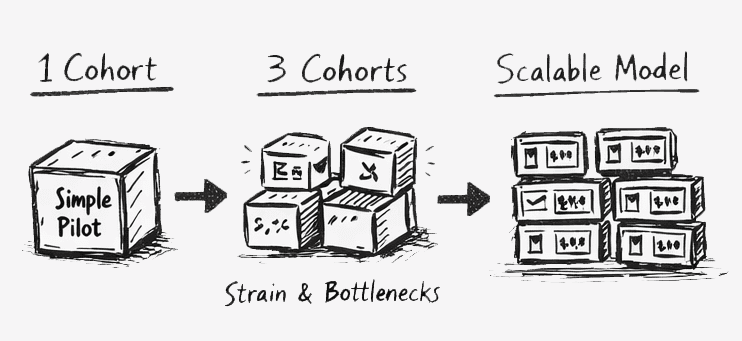
The first version launched with the initial cohort. It worked. We had live validation that the system could handle growth. Early signals:
16 of 18 seats filled in cohort one
80% of students finished prep materials before the course started
Adoption: Students and instructors started using the platform immediately. It replaced a messy stack of tools with one unified system.
The inflection point
Within the first year, demand accelerated:
Three parallel cohorts running at once
Near-full enrollment across the board
Increasing complexity from mixed formats (on-site + remote)
The original architecture couldn't keep up.
I led a redesign using synced databases and modular cohort logic. This let us:
Duplicate cohort structures quickly
Push curriculum updates to all active cohorts from one place
Cut down manual coordination between instructors and formats
What changed operationally
Cohort setup went from ~3 days to ~8 hours
Way less coordination overhead for instructors and program managers
We shipped the redesign without disrupting active cohorts or forcing retraining. Delivery kept running smoothly during peak growth.
Impact
OPERATIONAL SCALABILITY
With the iteration, the LMS became the core operational infrastructure for the program, instrumental in enabled the organization to scale rapidly:
team growth from 2 → 8 members in the first year
later expansion to 12 team members after merger
6 cohort streams running in parallel
Operational processes that had previously been fragmented across multiple tools were now embedded directly in the workflow.

reflection
This project accelerated my growth as a systems designer and team leader.
I learned how to:
Make autonomous decisions under time pressure
Balance immediate delivery with long-term scalability
Design systems that coordinate complex workflows
Foster team growth while keeping things stable in a fast-scaling environment
One principle that guided the work: MAYA (Most Advanced Yet Acceptable). Introduce improvements without overwhelming people.
The result: a system that let the organization scale while keeping the experience stable for students and instructors.